Quick Guide to Goal Setting
What are goals?
Goals are the most important way to set expectations that include both key RESULTS of what needs to be accomplished and BEHAVIORS, or how the results are accomplished over the next year.
Note: Goals do not need fit an annual time frame – they may get done before the end of the year or carry over to the next cycle.
Why should I set goals?
- Well-designed goals guide priorities and efforts and set the agenda for the year.
- Setting meaningful goals is one of the most powerful ways to foster motivation, focus contributions, and improve performance.
- Clear and relevant goals are the foundation for effective coaching and feedback as well as for performance evaluations.
How do I set goals?
Simply follow the steps which outline the best practices below.
01
CLARIFY BROADER PRIORITIES
What are the broader priorities for your unit or college? Depending on how goals are developed, these priorities may be more or less formal, but they generally explain how your team or department contributes to the University’s overall mission. Identifying and describing the broader priorities will allow you to:
- Focus on the most important work
- Communicate the IMPACT of work
- Describe how individual goals contribute to the broader priorities and goals.
Examples of connecting impact to broader priorities:
Impact:
Enhance the student experience in Financial Aid by delivering clearer, more timely support, leading to improved student satisfaction and reduced frustration when navigating the aid process.
Impact:
Implementing a more effective data analysis tool will improve efficiency and productivity across the lab, allowing us to complete work faster and support larger‑scale projects.
02
CONSIDER ROLE AND SKILLS
With broad priorities in mind, consider:
- Current skills and development needs: Do you have the knowledge and skills needed to be successful in your role? What skills are needed for the role in the future? What is the challenging part of your job right now? How can you develop stronger skills in that area?
- Interest/motivation: What is motivating for you in your current role? What would be a meaningful project for you to focus on next?
- Experience and mastery: How well do you know your role? What is your current performance?
03
IDENTIFY UP TO THREE GOALS
Identify up to three goals that are most important for you over the next year. Include expectations for BOTH results and behaviors (the “what” and the “how“).
Describe the most important results you need to achieve.
Examples:
Result:
Complete the student services process improvement project by the end of October.
Result:
Determine two viable options for replacing the current data analysis tool and evaluate the pros and cons of each by the end of February.
Describe how you need to achieve these results. In other words, identify and describe the behavioral competencies* (i.e., skills, knowledge, abilities, and other characteristics) that will be most important.
Examples:
Behavior:
Consistently looks past initial symptoms to identify underlying issues and root causes of problems.
Behavior:
Regularly shares relevant updates and information so others stay informed and issues are addressed early.
Goals vs. Tasks
All work includes both the big projects that help move the unit or college forward and the everyday tasks that need to be done. Sometimes, individual goals end up looking more like a task list or job description instead of focusing on a few meaningful contributions that have a bigger impact. To make sure goals are truly goals—and not just a list of tasks—it helps to clearly distinguish between these different types of work.
Goals: Goals describe a few larger contributions that push you outside of your comfort zone and take time to accomplish. Effective goals are not something that can be done in a day and they commonly are a set of multiple smaller tasks that need to be done.
Tasks/Activities: Tasks/Activities are the smaller, simpler daily routine tasks. Because they are smaller and less complex, they can usually be checked off the list by the end of the day/week.
04
DISCUSS AND INVITE INPUT TO FINALIZE GOALS
Goal-setting is a two-way street, you will be more likely to find the goals meaningful and motivating if this is a collaborative exercise between you and your manager. Consider:
- Are the goals limited in number? Effective goals identify the few important longer-term projects you need to get done during the year. Limit to no more than three.
- Are goals specific, measurable, achievable and time bound? Would achieving these goals be a meaningful and significant accomplishment? Goals should be challenging enough that they push you outside of your comfort zones but are achievable with significant effort.
- Do goals show impact on broader priorities? Effective goals should align with your unit or college’s strategies and support the broader priorities of the university.
- Do goals include BOTH results and behaviors? Effective goals should describe the most important results you need to achieve and how you need to achieve these results.
Example Goals:
| Goal 1. Student mentoring to enhance student experience. |
| Increase the leadership skills and interests of students (IMPACT) through actively and effectively mentoring college students (RESULTS) during the semester. Move FROM waiting for students to ask for mentoring and guidance TO proactively identifying opportunities to offer mentoring and guidance to students and then acting on those opportunities (BEHAVIOR). |
| Goal 2. Improve process to reduce waste. |
| Over the next year, implement a new process to reduce inventory/waste by 10% (RESULTS) to improve operational efficiencies (IMPACT). Move FROM accommodating multiple requests on an “ad-hoc” basis TO designing and implementing a workflow that would help meet most of the requests in a consistent manner (BEHAVIOR). |
05
CHECK-IN TO REVIEW PROGRESS AND UPDATE GOALS
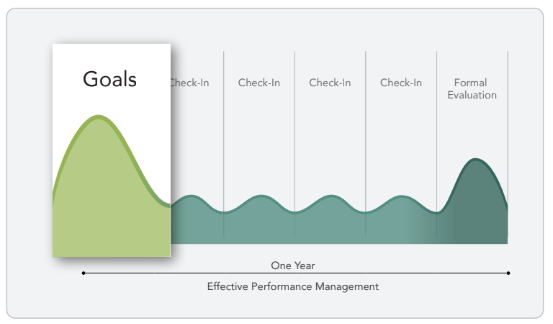
Goals need to be flexible and reflect the dynamic nature of the work. Priorities can shift during the course of the year, so it’s important not to fall into the “set-and-forget” trap of writing goals and not looking at them again until review time. It is most effective if goals are set at the beginning of the performance cycle, but if they are not set then, it’s never too late to set goals at other times during the year. Goals should be updated, added or marked off as they are completed. Have ongoing check-ins on a regular basis to discuss progress toward the broad annual goals, to update and revise them.