Quick Guide to Performance Evaluation
What is performance evaluation?
Performance evaluation includes measuring effectiveness in meeting expectations for achieving results as well as how those results are achieved (i.e., behaviors).
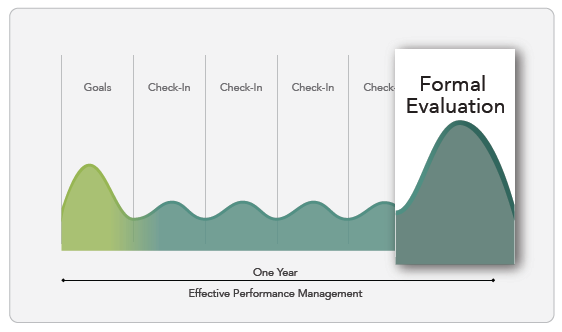
Effective performance evaluation does not happen only at the end of a year but through ongoing check-ins throughout the year.
Formal evaluation is the final step in the performance management process and includes writing and delivering a performance evaluation.
Ideally, a formal evaluation is a summary of what has already been discussed throughout the year.
How do I conduct performance evaluation?
Simply follow the steps which outline the best practices below.
01
GET EMPLOYEE INPUT ON THEIR RESULTS AND IMPACT
Ask employees to summarize their key results and accomplishments for the year using the Kuali performance evaluation form. This increases communication and understanding when reviewing their input, decreases disconnects between your view and the employee’s view of their performance and increases employee ownership and acceptance of the process.
02
GET INPUT FROM OTHERS
If appropriate, you may want to gather input from an employee’s peers, direct reports, or key partners in other departments. Think carefully about how useful and relevant that feedback is, and weigh it alongside other information you have, such as your own observations or available data. If you choose to use feedback from multiple sources, focus on using it to support learning and growth rather than as a formal performance rating.
03
EVALUATE THE RESULTS THE EMPLOYEE ACHIEVED
From the employee’s input on the Kuali performance evaluation form, identify the employee’s most important accomplishments of the past year. Determine the impact those accomplishments had on the department, college or unit and the contribution they made to important goals and priorities. For example:
| Results | Example – Employee Input |
|---|---|
| Context | One of my most important accomplishments this year was helping our new director of student services quickly learn how our office works, who the important people are within the college and across the University, and how to build good working relationships with our faculty and associate deans. |
| Accomplishment | I created the onboarding plan and took responsibility for ensuring that it happened. |
| Impact | My efforts allowed our new director to learn her role quickly and start identifying opportunities to improve student services within just a few weeks. |
04
EVALUATE HOW THEY ACHIEVED RESULTS
Identify how the employee was expected to achieve results. Including behaviors in the evaluation process is an important way of differentiating between employees who are performing more or less effectively than others.
| Behaviors | Example – Employee Input |
|---|---|
| How | One of my goals for the year was to increase my effectiveness in focusing on important issues and projects without getting distracted by unimportant or low priority details. I demonstrated that I was able to focus my time and effort on my 3 most important projects, while effectively managing a number of lower priority issues that arose throughout the year. As a result, I was able to complete my projects on time. |
05
WRITE THE PERFORMANCE REVIEW NARRATIVE
The Narrative
Take the time to be thoughtful and specific, as the narrative will be the most useful portion of the review for the employee. Narratives provide important feedback that helps the employee understand how they are performing relative to the expectations for their role. Complete the narrative by answering the questions on the Kuali performance evaluation form.
Specific Examples
Write a narrative to include specific behavioral examples.
- Be sure to describe the results achieved and the impact of those results.
- Examples of accomplishments provided by the employee and others can be incorporated into the narrative.
- Examples provided in narratives also identify areas for growth and development over the next year, setting the stage for goal-setting.
Reason for Rating
Include the reason for rating to help the employee understand why they received a particular score.
The Rating Scale
A simple three point rating scale in which each point on the scale is defined in a consistent and fair manner is required on the form. The ratings are as follows: Exceeds Expectations, Meets Expectations, and Requires Improvement.
06
DISCUSS THE REVIEW WITH THE EMPLOYEE
Context
If you had formal or informal ongoing check-ins throughout the year, summarize these discussions in the annual review conversation to provide context.
Narrative & Rating
Provide employees with a written review prior to your discussion so that they a chance to familiarize and reflect. Discuss the narrative, the performance rating, and the rationale for the rating the employee received. Discuss both the results the employee achieved as well as how they achieved those results (i.e., behaviors).
Input
Ask the employee to share their thoughts and opinions on each portion of the review.
Plan ahead for the next year
Talk about goals and developmental activities for the next year:
- Goals: If you aren’t already doing so, consider setting broad annual goals for next year and then using ongoing flexible goal-setting for specific shorter-term goals. Keep the broad goals specific, important and measurable.
- Development: The review session is often a good time to begin creating a development plan. Focus on the specific behaviors and skills that will help the person be successful in achieving the goals ahead.